The Moment Everyone Saw
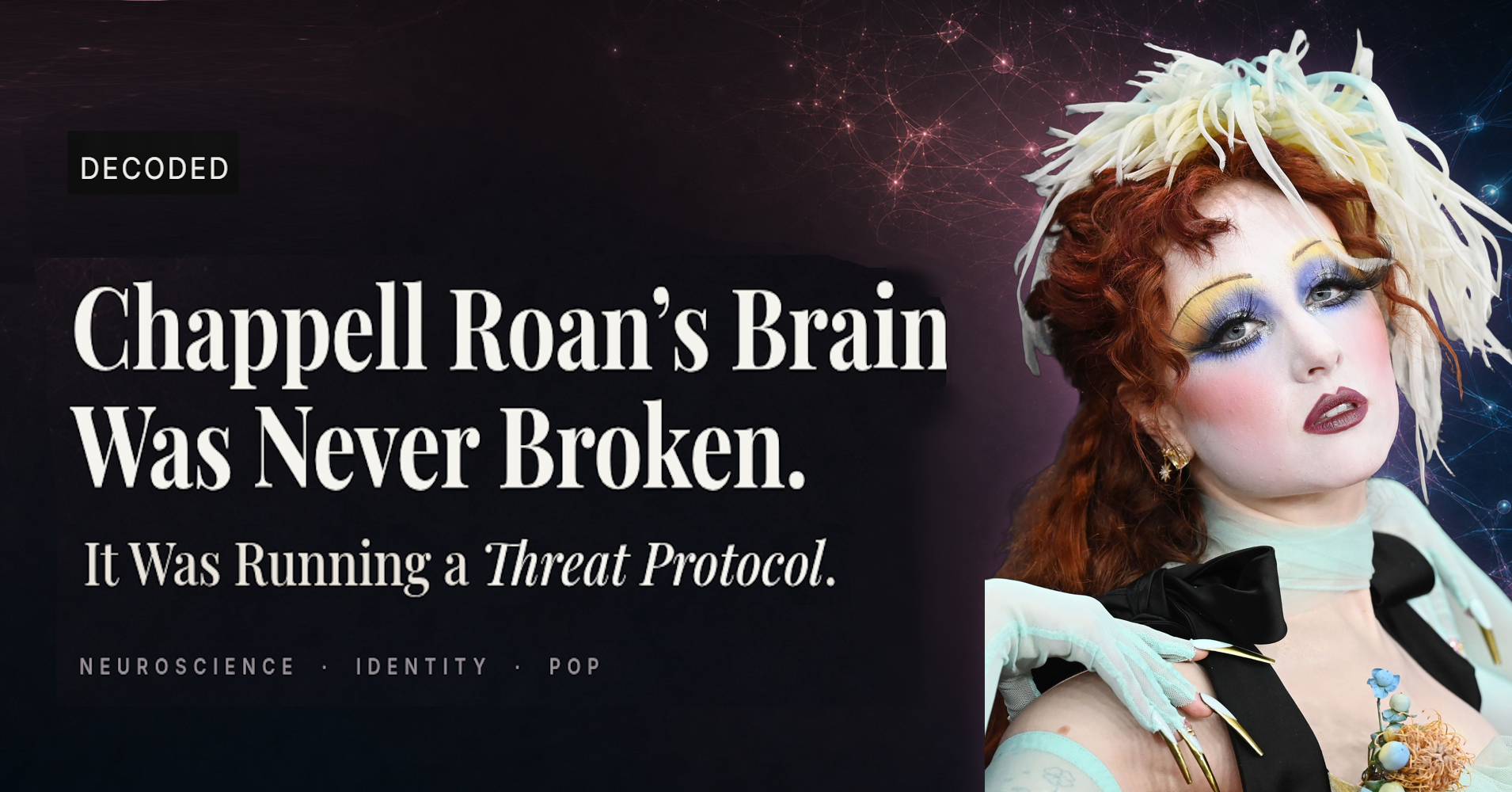
She wasn't crying. She wasn't shaking. She looked directly into the camera — no stylist, no soft lighting, no PR-approved framing — and said it plainly: *I don't owe you anything.* In August 2024, Chappell Roan posted a video to her verified Instagram account addressing fans directly, calling out parasocial relationships she described as having become genuinely unsafe. The internet processed this in the way the internet processes most things that don't fit a tidy narrative: it called it a breakdown. A meltdown. A star behaving badly at the worst possible moment.
What it actually was, viewed through the lens of how the human brain processes threat, was something far more precise and far less dramatic. It was a security protocol executing on schedule.
What the Media Said
The conventional narrative assembled itself quickly, as conventional narratives do. Here was a young woman from a small town in Missouri who had clawed her way to the top, finally arrived at the moment every aspiring artist dreams of, and then — inexplicably — started biting the hand that fed her. The fans who had made her famous felt spurned. The think-pieces arrived. Was she ungrateful? Difficult? Had fame revealed a character flaw that the carefully constructed persona of Chappell Roan had been concealing all along?
The entertainment press, to its credit, occasionally gestured toward the mental health angle. In September 2024, Roan told The Guardian she had experienced what she described as a mental health crisis during her rapid rise, that she had been, in her own words, not equipped for the scale of attention she received. This was reported as confession, as vulnerability, as the star finally admitting she had struggled. What it was rarely reported as was evidence. Evidence that a normal nervous system, placed inside an abnormal situation, had responded in the only way it knows how.
The story the media told was about a person. The more interesting story is about a brain.
The Science Underneath
Here is something the amygdala — the brain's primary threat-detection structure — does not do: read context. It does not distinguish between a predator closing in and a crowd of strangers who feel, with genuine warmth and genuine entitlement, that they have a relationship with you. Research by neuroscientist Joseph LeDoux at NYU established that the amygdala's threat-response architecture evolved under conditions that predate the concept of celebrity by several hundred thousand years. It evolved to detect physical danger, social exclusion, and territorial violation. When it detects any of these, it triggers the same cascade: cortisol and adrenaline flood the system, attention narrows, the body prepares to fight or flee.
The critical detail is that this cascade is not optional and it is not overridable by rational thought alone. You cannot logic your way out of a cortisol spike. You can know, consciously and completely, that the person approaching you in an airport means no harm — and your nervous system will still register the approach as a potential incursion if the conditions are right. Millions of strangers who feel they know you intimately. A total collapse of the boundary between public and private self. The constant monitoring of your behavior, your statements, your moods, your body. These are not abstract pressures. To the amygdala, they are inputs. And the amygdala has one output setting for inputs of this kind.
Research on the phenomenology of sudden, extreme fame — particularly work examining what happens when public recognition outpaces an individual's psychological preparation — has documented a consistent pattern: heightened anxiety, identity disruption, and hypervigilance. The experience of being famous, from the inside, involves a persistent and exhausting sense of being watched, of private selfhood dissolving under the pressure of public projection. This is not a weakness of character. It is a documented response to a genuinely novel set of conditions that human neurology was never designed to handle.
Chappell Roan had no runway. There was no gradual acclimation, no slow climb that might have allowed her nervous system to calibrate. She signed with Atlantic Records at seventeen after posting covers on YouTube. She was dropped in 2020, during the pandemic, after her debut album underperformed — a period she has described as one of the lowest points of her life. She spent years in what the industry calls the wilderness. Then *The Rise and Fall of a Midwest Princess* was released in September 2023, climbed to number four on the Billboard 200 on the back of TikTok and word-of-mouth, and by 2024 she was everywhere, all at once. She won Best New Artist at the 2025 Grammy Awards. The vertical ascent from dropped artist to Grammy winner happened so fast that her nervous system, by any reasonable neurological standard, never had the chance to learn that this particular kind of exposure was survivable.
Two Drives, One Body
Building on behavioral frameworks from neuroscience on the three instinctual drives — self-preservation, sexual, and hierarchical social — what Roan's public behavior reveals is not instability but collision. A system running two incompatible programs simultaneously.
The hierarchical drive is the one that got her here. It is the force that compels human beings toward recognition, toward visibility, toward the need to matter in the social world. It is what made a teenager from Willard, Missouri post covers on YouTube and keep posting them. It is what kept her writing and performing through the years after Atlantic dropped her. It is what fuels the artistic ambition visible in every performance — the elaborate costuming, the theatrical commitment, the refusal to make small music. The hierarchical drive does not want to disappear. It wants to be seen.
The self-preservation drive is the one that produced the Instagram video. It is the system that monitors threat, maintains the integrity of the organism's boundaries, and sounds the alarm when those boundaries are being violated. Fan intrusion. Parasocial entitlement. The expectation of unlimited access. The pressure to perform a self that is not the self currently being experienced. These are, to the self-preservation system, violations — and violations require response.
Neither drive is pathological. Both are doing exactly what they were built to do. The problem is that they are pulling in opposite directions with equal force, and there is no resolution available that satisfies both simultaneously. You cannot be fully seen and fully protected at the same time. You cannot be the artist the hierarchical drive wants to be and the private person the self-preservation drive is trying to protect. This is not a personal failing. It is a structural impossibility.
Unresolved internal contradictions of this magnitude do not stay quiet. They cannot be managed into stillness through willpower or media training or a good publicist. The pressure builds because there is nowhere for it to go, and when it finds an exit — a camera, a comment section, an Instagram video — it exits. What looks from the outside like erratic behavior is, from inside the system, the only logical response to an irresolvable conflict.
Roan built her entire artistic identity around radical authenticity and queer visibility. She has spoken openly about her upbringing in a religious household in rural Missouri, about the psychological cost of concealing her identity during adolescence, about what it meant to spend years performing a self that wasn't real. The machinery of mainstream fame then asked her to do a version of the same thing: to surrender personal boundaries, to perform accessibility, to become a product that exists for consumption. The structural contradiction at the center of her public life — *I must be seen to matter* versus *being seen is destroying me* — is not incidental to her behavior. It is the engine of it.
The Performance She Refused
The entertainment industry runs on an implicit contract, and the terms are rarely written down because they don't need to be. You receive fame; you perform gratitude. You are overwhelmed; you perform resilience. You are violated; you perform graciousness. The audience gives you their attention and their money, and in return you give them the emotion they need you to have about all of it: joy, humility, warmth, and above all, the reassurance that this is what you wanted and you are so glad they are here.
This is what behavioral science calls a Happiness Performance — the systematic presentation of emotional states that do not match internal experience, sustained over time under social pressure. It is not unique to celebrities. Most people do versions of it daily, in offices and family dinners and social media profiles. The difference is one of scale and consequence. For most people, the performance has natural breaks. For a pop star in 2024, it is theoretically continuous. Every public appearance, every fan interaction, every interview is another occasion to demonstrate that you are grateful enough, accessible enough, happy enough to justify the attention.
Roan was expected to perform gratitude at the exact moment she was, by her own account, experiencing psychological crisis. The gap between the required performance and the actual internal state is not a gap most people can sustain indefinitely. Some people can sustain it longer than others. Roan, it turns out, could not sustain it at all — and this should not be surprising, given what we know about her history.
She spent her adolescence in a religious household in rural Missouri, concealing a queer identity that the community around her would not have accepted. She has described this period in multiple interviews as one of profound psychological cost. She knows, in a way that is not abstract but viscerally biographical, what it costs to perform a self that isn't real. She has paid that price before. She is constitutionally, experientially, and now professionally allergic to performing emotions she doesn't feel. What the public read as a series of ruptures was something more coherent: the refusal, by a person with very specific reasons to refuse, to maintain a performance she was never going to be able to sustain.
What the Evidence Actually Shows
The Grammy speech is the piece of evidence that most disrupts the breakdown narrative, and it is worth sitting with. At the 2025 Grammy Awards, having just won Best New Artist, Roan used the platform to advocate for healthcare for working musicians. The statement was prepared. It was policy-specific. It named a real structural problem in the industry and directed attention toward it with precision. This is not the behavior of someone who is dysregulated. It is the behavior of someone who is strategically redirecting — who looked at a moment of maximum visibility and decided to use it for something other than the expected performance of gratitude.
The DNC refusal, similarly, is not impulsivity. Roan told Variety directly that she was uncomfortable with political alignment and believed celebrities should not be used as political props. You can agree or disagree with the position, but the position is coherent, values-based, and held under significant pressure. The Instagram video — *I don't owe you anything* — is not a crisis communication. It is a threat-response communication, delivered clearly and without apology, to an audience that had crossed a boundary she had determined was real.
None of these moments, viewed individually or together, suggest a person who is losing control. They suggest a person whose nervous system is running a consistent program: detect violation, name it, establish boundary, redirect where possible. The program is not always elegant. It is not always received well. But it is coherent, and coherence is not a quality we typically associate with breakdown.
What We're Actually Watching
Pull back far enough, and what Roan's public behavior represents is something larger than one artist's difficult year. It is a live experiment in what happens when a human nervous system — a normal one, running normal programs under abnormal conditions — refuses to pretend it isn't a human nervous system.
The parasocial architecture of contemporary fame is built on a specific fiction: that the relationship between artist and audience is mutual, that the fan's feeling of intimacy corresponds to something real on the other side of the screen. For most of the history of celebrity culture, artists were asked to maintain that fiction, and most of them did, at significant personal cost. Roan is declining to maintain it. She is saying, with some force, that the fiction is a fiction — that what feels to the fan like a relationship is, from her side of it, exposure. And her nervous system, which cannot distinguish between a stalker and a devoted fan at the level of threat-detection, is backing her up.
The audience that labeled her behavior a meltdown, that felt entitled to her warmth and her access and her performed gratitude, may be the same audience whose behavior activated the protocol in the first place. That is not a comfortable thing to consider. It is also, neurologically speaking, the most accurate reading of what happened.
The brain cannot always tell the difference between danger and exposure. But it can, over time and under the right conditions, learn to calibrate. The question worth sitting with is not whether Chappell Roan will eventually learn to manage her threat response more gracefully. The question is whether the people watching her — the fans, the press, the industry, the audience reading this — are capable of examining the role they played in triggering it. And whether, having examined it, they will do anything differently.
Probably not. But the fact that the question can be asked at all is, in its own uncomfortable way, a start.