The Letter
In April 2025, a letter arrived at the office of Iran's Supreme Leader Ali Khamenei. It carried no diplomatic scaffolding, no preliminary expression of mutual interest, no acknowledgment of shared stakes. What it carried was a deadline and a consequence. Trump made the substance public almost immediately, telling reporters that Iran needed to move quickly, or, in his words, something bad was going to happen.
Conventional diplomatic openings don't look like this. They involve back-channel signals, exploratory language, the careful construction of face-saving exits for both sides. They are, by design, ambiguous — because ambiguity gives everyone room to maneuver without losing status. What Trump sent was the opposite of ambiguity. It was a flare gun fired through a window.
The reflexive interpretation — reckless, destabilizing, dangerous — arrived within hours. So did the counter-interpretation: brilliant pressure, maximum leverage, the art of the deal applied to the most dangerous negotiation on earth. Both readings share a flaw. They start with the politics and work backward to the person. The more interesting question runs in the other direction: what does this behavior tell us about the cognitive architecture producing it? And what does that architecture tell us about ourselves?
The Constructor Mind
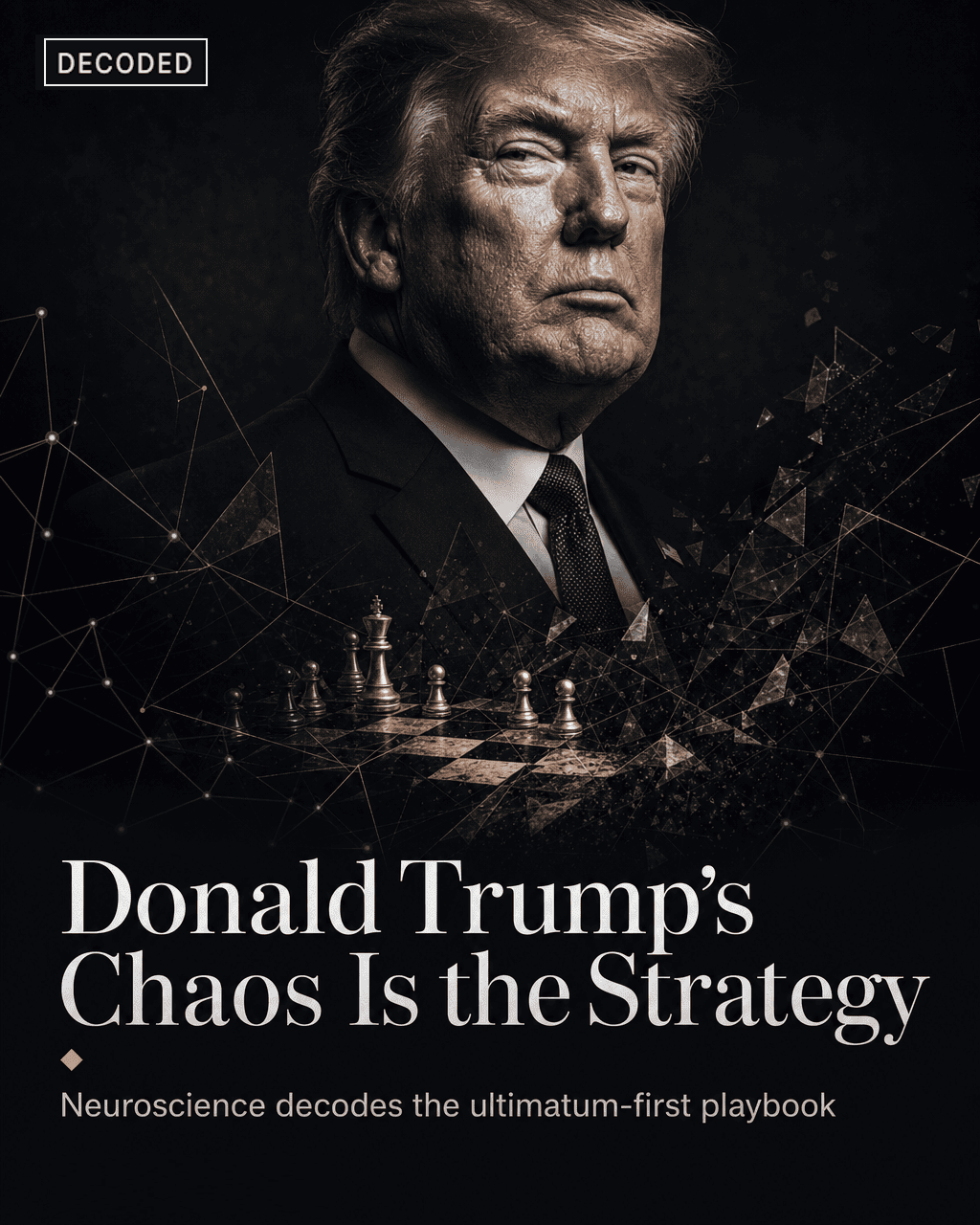
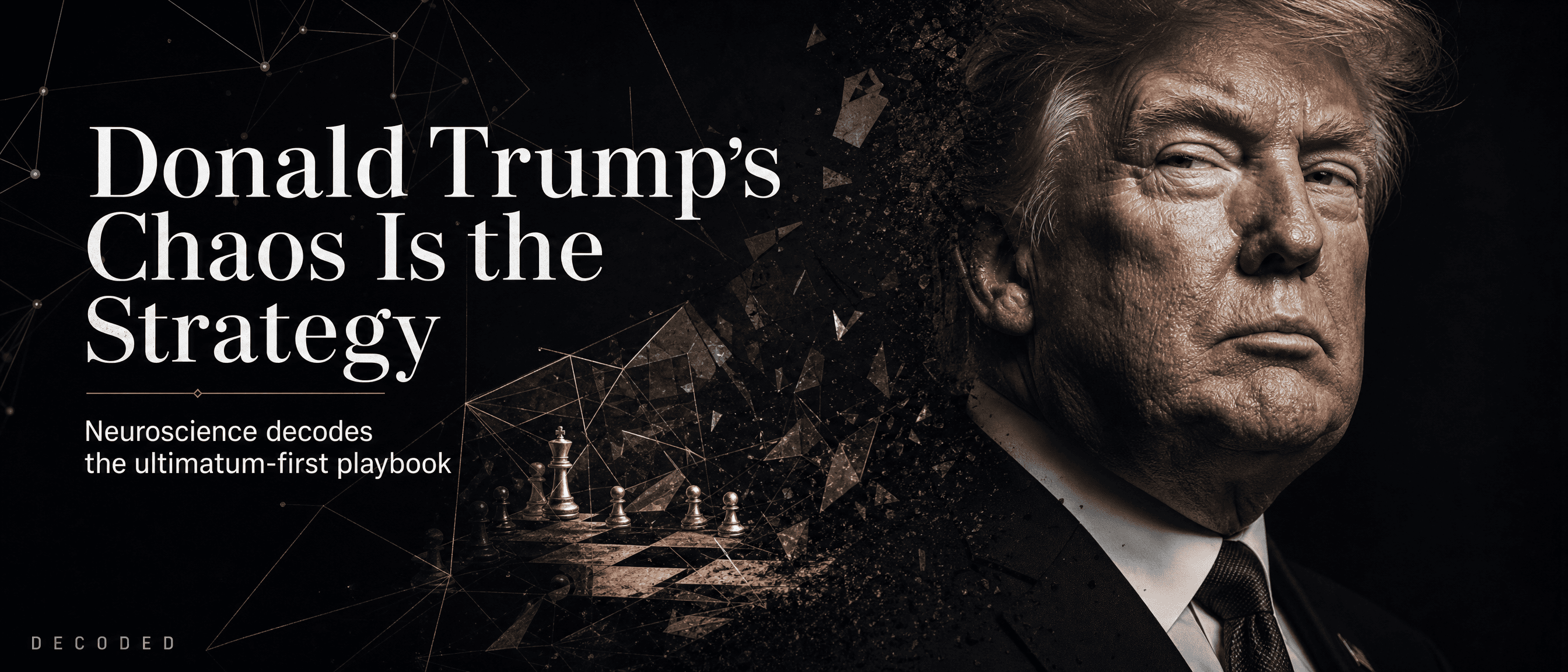
Drawing on the cognitive typology developed by neuroscientist Andrei Kurpatov, Trump's negotiation behavior maps most consistently to the Constructor type — a mind that processes reality through outcomes and structural demolition rather than process or relational nuance. The Constructor doesn't experience ambiguity as productive tension. It experiences ambiguity as a problem to be resolved, usually by force of position. The existing framework isn't a starting point to be refined; it's an obstacle to be cleared.
This is not a flaw in the Constructor type. It is the type's defining feature, and in the right structural conditions, it produces results that more process-oriented minds cannot. But it does create a characteristic signature in high-stakes negotiation: the Constructor tends to exit before renegotiating, to demolish before building, to establish dominance of position before exploring the substance beneath it.
The 2018 JCPOA withdrawal is the clearest available data point. On May 8, 2018, Trump withdrew the United States from the Joint Comprehensive Plan of Action, describing it publicly as a horrible, one-sided deal that should have never, ever been made. He didn't renegotiate from inside the existing framework. He left it, declared it worthless, and positioned any future agreement as something that would have to be built from scratch — on his terms, from outside the structure he'd just destroyed.
To a process-oriented mind, this looks like burning the building down. To a Constructor, it's clearing the site. The distinction matters enormously, because it means the behavior isn't impulsive in the clinical sense — it's architecturally consistent. Trump articulated the underlying logic decades before he held office: the worst thing you can do in a deal is seem desperate to make it, he wrote in his 1987 book co-authored with Tony Schwartz. The best thing you can do is deal from strength, or perceived strength. That's not a negotiating tip. It's a cognitive worldview compressed into two sentences.
What the Brain Does Under Dominance Conditions
The neuroscience here is less about Trump specifically and more about what any brain does when it interprets a high-stakes interaction as a dominance contest rather than a collaborative problem.
Research by Thayer and Lane, published in Neuroscience & Biobehavioral Reviews, established that prefrontal cortex activity and amygdala reactivity exist in an inverse relationship during threat-appraisal tasks. When the brain reads a situation as threatening — when the social stakes feel like survival — the slower, more integrative prefrontal systems cede ground to faster, threat-reactive circuits. The result is a mind that becomes very good at detecting danger and asserting position, and less available for the kind of nuanced, multi-variable thinking that finds creative solutions in complex negotiations.
This dynamic is compounded by a biological feedback loop that research published in Hormones and Behavior has documented in detail. Winning a dominance exchange — or even perceiving that you've won one — triggers a rise in testosterone and a drop in cortisol, a hormonal state that then primes the individual for more dominance-seeking behavior in subsequent interactions. The brain, in other words, rewards its own aggressive posturing. Each perceived win makes the next ultimatum feel more natural, more correct, more obviously the right move.
This is not a character indictment. It is a documented loop, operating in human nervous systems across the full political spectrum. The relevant question — the one neuroscience can pose but not answer from the outside — is whether this loop is being consciously leveraged as a strategy, or unconsciously inhabited as the only available mode.
Loss Aversion as Statecraft
There is a specific mechanism by which Trump's framing tends to operate, and it maps with unusual precision onto one of the most replicated findings in behavioral economics.
Kahneman and Tversky's Prospect Theory, now foundational to how economists and psychologists understand decision-making, established that losses are psychologically weighted roughly twice as heavily as equivalent gains. We feel the sting of losing a hundred dollars more acutely than we feel the pleasure of gaining the same amount. Subsequent research confirmed that framing a negotiation outcome in terms of what the other party stands to lose — rather than what they might gain — systematically increases concession rates.
Trump's public framing of the Iran standoff is almost a textbook application of this principle. The language isn't about what Iran could gain from a new agreement. It's about what Iran will lose if one isn't reached. Something bad is going to happen. They will lose everything. The worst deal ever — implying that the alternative to his deal is catastrophe, not merely a missed opportunity. Whether this framing is consciously derived from loss-aversion theory or simply reflects an intuitive grasp of how threat activates human decision-making, the mechanism is the same.
But there's a critical threshold, identified in a 2021 meta-analysis covering 71 negotiation studies: extreme anchor offers — the opening positions that establish the terms of what's possible — only produce better outcomes for the party making them when the counterpart perceives the anchor as credible. When the anchor is read as a bluff, it triggers reactance: the other party digs in, concession rates drop, and the aggressive opening position becomes a liability rather than an asset. The Iran case sits precisely at this credibility threshold. Whether Trump's military threat is perceived in Tehran as a genuine red line or a negotiating posture determines whether the entire approach succeeds or collapses — and that perception is largely outside Trump's control.
The Other Brain in the Room
Negotiation research has documented something that should give anyone pause when analyzing high-stakes standoffs: emotional states are contagious between negotiating parties, and the contagion operates below conscious awareness.
Work published in Administrative Science Quarterly found that when one negotiator enters a dominance-threat mode — projecting anger, asserting superiority, signaling willingness to walk — the counterpart's nervous system mirrors that state, reliably and without intention. The result is that both parties end up operating from amygdala-driven frames simultaneously, and the cognitive space available for integrative, creative problem-solving — the space where deals actually get made — contracts sharply.
This is the structural risk embedded in ultimatum-first negotiation: it doesn't just shape the negotiator's own cognitive state. It shapes the counterpart's. Iran's public responses to Trump's 2025 ultimatum have themselves escalated in threat-language, a pattern of reciprocal hardening that the emotional contagion research would predict. This isn't a description of Iranian decision-makers' psychology — it's a description of what adversarial dominance posturing does to any negotiating system, regardless of who's on the other side of the table.
When the System Works
It would be intellectually dishonest — and analytically lazy — to treat the Constructor's demolish-then-build approach as simply dysfunctional. The evidence doesn't support that conclusion.
The Abraham Accords, brokered by the Trump administration and signed in September and October of 2020, normalized relations between Israel and the UAE, Bahrain, Sudan, and Morocco. The Brookings Institution described the agreements as the most significant shift in Arab-Israeli relations in a generation. The same cognitive profile that produced the JCPOA walkout produced this outcome — transactional, dominance-anchored, focused on structural results rather than process legitimacy.
The difference wasn't the cognitive type. It was the structural conditions. The Abraham Accords involved parties who shared a common threat perception — Iran, notably — and had strong economic incentive alignment. Crucially, the existing framework being dismantled (Arab-Israeli non-recognition) had no powerful internal constituency actively defending it. The Constructor's instinct to clear the existing structure and build something new found terrain where that instinct could produce results.
The Hanoi summit with Kim Jong Un in February 2019 illustrates the other side of the ledger. Trump walked out when North Korean demands proved unacceptable, describing the walkout afterward as a deliberate choice. The same playbook — establish dominance, anchor high, be willing to leave — produced no agreement, because Kim's own dominance calculus made concession impossible without a reciprocal loss of face that his political survival couldn't absorb. Two Constructor-type minds in the same room, both running the same threat-reward logic, both unable to yield without losing rank. The cognitive type was consistent. The structural conditions were incompatible.
The Diagnostic Question
Building on behavioral frameworks from neuroscience, the hierarchical-social drive — the instinct to establish and defend dominance rank — appears to be the primary engine beneath Trump's negotiation posture. This drive is visible across adversaries: Iran, North Korea, NATO allies, domestic political opponents. The specific geopolitical content changes; the underlying behavioral grammar doesn't. Ultimatum. Walkout threat. Maximum pressure. The narrative pre-loaded so that any failure belongs to the other side.
This last element — what might be called blame architecture — is worth naming precisely. Trump's public framing of the Iran standoff consistently externalizes responsibility for failure onto the prior JCPOA framework and onto Iranian leadership, while positioning any future breakdown as the other side's choice. This isn't spin in the ordinary sense. It's a structural move that insulates the negotiator's cognitive identity from the outcome: if it works, it's the deal; if it fails, it's the other side's decision. The Constructor's sense of self remains intact either way.
Kurpatov's framework raises a question the article cannot answer from the outside, and deliberately won't try to: is Trump's Iran posture the output of a Constructor operating at full capacity — deploying dominance-signaling as a conscious instrument, calibrated to the specific structural conditions — or a Constructor operating without the integrative checks that make the type genuinely effective? The cognitive architecture is visible in the public record. What's inside it remains, as it always does, opaque.
The Mirror
Here is where it gets uncomfortable.
Every reader has a version of this. The negotiation entered with ultimatums because vulnerability felt more dangerous than deadlock. The relationship conversation opened with a threat because asking felt like losing. The job offer rejected on principle when the real issue was that accepting felt like conceding something. The deal walked from not because the terms were wrong but because the other side didn't blink first.
The Trump-Iran standoff is an extreme, high-stakes expression of cognitive patterns that are human and documented and available to all of us under sufficient pressure. The dominance loop, the loss-aversion framing, the blame architecture that keeps failure always at someone else's address — these are not the exclusive property of any political figure. They are what nervous systems do when they read the situation as a contest for rank rather than a problem to be solved together.
The question neuroscience leaves open — for Trump, for Iranian negotiators, for anyone who has ever entered a room with a position instead of a curiosity — is the one that's hardest to answer in the moment: when your brain defaults to dominance, are you choosing a strategy, or is the strategy choosing you?