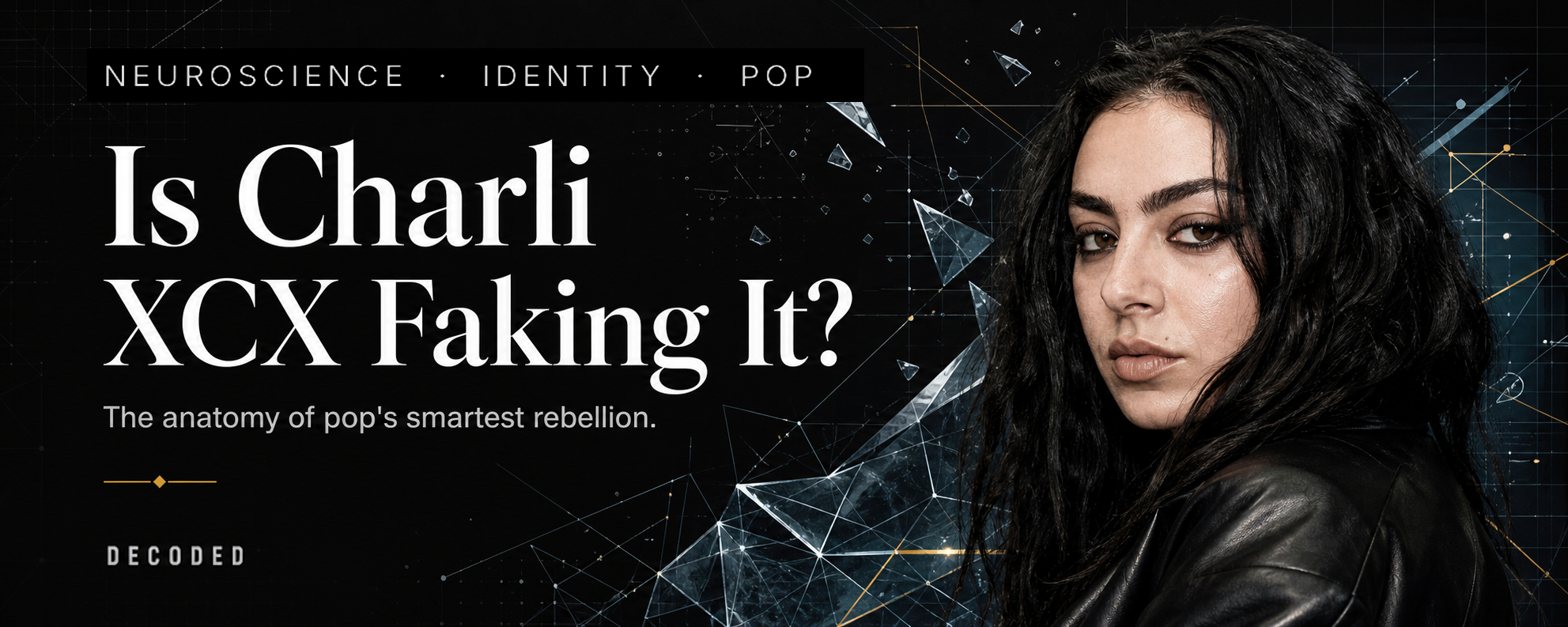
The Room That Wasn't There
In July 2024, Charli XCX posted two words on social media — *kamala IS brat* — and something unusual happened. The internet didn't debate it. It didn't push back. It collapsed, almost instantly, into agreement. Within days, the Harris campaign had adopted the branding. The Associated Press was filing copy about it. Merriam-Webster was logging 'brat' among its most searched terms of the year. A pop star had apparently read a political moment with such precision that her two-word dispatch became a kind of cultural decree.
Or had she? That's the more interesting question — and the one neuroscience is better equipped to answer than political journalism.
Because there are two ways to read what happened that July. The first: Charli XCX has an extraordinary antenna for cultural frequency, a rare ability to sense what a moment needs and name it before anyone else can. The second, more unsettling possibility: she didn't read the room at all. She projected her own internal world onto it with such force and such certainty that the room reorganized itself to match. And we called that genius.
Both things can be true. That's the cognitive puzzle at the center of one of pop music's most celebrated careers.
What the Story Says
The conventional narrative about Charli XCX — born Charlotte Emma Anning in Cambridge, England, signed to a record label at sixteen after performing at illegal raves, now the architect of one of 2024's most culturally saturated albums — is essentially a story about authenticity as rebellion. She is, by the media's accounting, the artist who refuses to perform conventional pop-star gratitude. Who says what she thinks. Who pushes back at fans on social media, as she did in a documented 2019 incident that was widely covered not as a scandal but as evidence of her refusal to perform the expected celebrity theater of appreciation.
She has described 'brat' — the self-identification that anchors her 2024 album, which debuted at number two on the US Billboard 200 — not as a marketing concept but as a genuine self-portrait. In an NPR interview in June 2024, she framed it as meaning something like: a little messy, likes to party, maybe says some dumb things sometimes. Raw material, not product. She has also told The New Yorker that she has always felt like an outsider in pop music — a statement that coexists, somewhat awkwardly, with the fact that 'brat' became one of the most discussed albums of the year and its central concept entered the American political lexicon.
The media has largely taken her at her word. Authenticity, in the critical vocabulary applied to Charli XCX, functions as both description and praise — the thing that makes her interesting, the thing that makes her trustworthy, the thing that separates her from the manufactured consensus of mainstream pop.
Neuroscience would like a word.
What's Actually Happening Underneath
The brain does not perceive reality and then report on it. This is the foundational insight that modern cognitive neuroscience keeps returning to, in different registers, across different research programs: the brain constructs reality, post-hoc, and then presents that construction to consciousness as though it were unmediated truth. We don't experience the world and then form opinions about it. We form a model, and then experience the model as the world.
This process — sometimes called the consciousness illusion — operates below the threshold of awareness. The story of why you did what you did, what you really meant, what the other person actually signaled: these are narratives assembled after the fact by a brain that is, at its core, a prediction engine running on prior experience. The feeling of perceiving clearly is itself a construction.
What this means for 'authenticity' is uncomfortable. When someone describes themselves as simply being real, as saying what they actually think without filter or performance, they are almost certainly describing an experience that is neurologically genuine — and perceptually incomplete. The internal narrative of realness is real. The claim that it corresponds accurately to external reality is a different matter entirely.
Layered on top of this is a well-documented phenomenon called the false consensus effect, first formally described by Lee Ross and colleagues in 1977 and since replicated across decades of social psychology research: individuals systematically overestimate the degree to which other people share their beliefs, preferences, and behavioral tendencies. The more certain we are of our own perspective — the more identity-invested we are in a particular self-concept — the more we assume that perspective is simply how things are. Not our view. The view.
And then there is naive realism, formalized by Ross and Andrew Ward in 1996: the tendency to believe that we perceive the world objectively while others are operating through bias. Naive realism intensifies under conditions of high self-certainty. The person most convinced they are seeing clearly is, neurologically, the person least likely to be running an active check on whether their perception is accurate.
Charli XCX, by her own account and by the account of everyone who has written about her at length, is a person of exceptionally high self-certainty. That is not a criticism. It is a cognitive profile.
The Closed Loop
Here is where the framework becomes genuinely illuminating rather than merely clinical. Drawing on the cognitive framework developed by neuroscientist Andrei Kurpatov, the Default Mode Network — typically used for tracking social relationships — can become colonized by abstract self-concepts, creating a closed perceptual loop. In other words: the neural system that is supposed to be modeling other people's minds, tracking their signals, updating our understanding of how they're actually responding to us, can be repurposed. Taken over. Devoted instead to elaborating and reinforcing an internal concept — a self-image, an aesthetic, an identity — that becomes so fully developed it functions as a substitute for genuine social perception.
The research on the Default Mode Network, including work by Andrews-Hanna and colleagues published in 2010, shows that this network generates spontaneous narratives about self and others — stories that feel like perception but are internally sourced. The DMN is active when we're thinking about ourselves, about our relationships, about our place in the world. It is also the network most likely to produce confident social 'readings' that never actually checked in with external reality.
In Charli XCX's case, 'brat' appears to function as exactly this kind of dominant internal object. It is a self-concept so thoroughly elaborated — so aesthetically complete, so emotionally invested, so publicly articulated — that it has become the lens through which all incoming social information is filtered. She doesn't receive signals from the room and then process them. She processes them through 'brat,' and what comes out the other side is a confirmation of 'brat.'
Building on behavioral frameworks from neuroscience, perceptual egocentrism describes the brain's default tendency to serve others what it would want itself — mistaking internal preference for universal signal. The artist who serves her audience radical provocation, aesthetic confrontation, and deliberate social discomfort is, on this account, serving what she herself would want to receive. And she reads their responses — the confusion, the devotion, the cultural argument — through that same filter. Resistance becomes proof of authenticity. Agreement becomes proof of resonance. The loop is closed.
This is not manipulation. It's not even self-deception in the ordinary sense. It is a specific cognitive architecture, and it is one that most human brains are running in some version, to some degree, most of the time.
The Evidence in Plain Sight
What makes Charli XCX a particularly interesting case study is that the public record contains evidence of genuine meta-awareness — which makes the authenticity claim more complex, not less. In 2022, she released 'Crash,' an album she described to Pitchfork as a conscious decision to make a more commercial record — a deliberate experiment in selling out, executed with full awareness of what she was doing and why. She was, in that moment, entirely lucid about the constructed nature of her own persona. She knew she was building something. She named it.
And then she returned to 'authenticity' as the organizing principle of 'Brat.'
This is not hypocrisy. It is something more interesting: a brain that is capable of stepping outside its own narrative when the stakes are framed as aesthetic experiment, but that defaults back to the narrative of realness when the identity investment is high. The 'Crash' detour was safe to be meta about precisely because it was framed as temporary, as performance, as controlled. 'Brat' is not framed that way. 'Brat' is framed as the truth.
The 2019 Twitter incident fits the same pattern. When fans pushed back, she pushed back harder — not with the performed graciousness that the celebrity-audience contract typically demands, but with what read as genuine irritation. The coverage celebrated this as authenticity. What it also was, neurologically, is a failure of perspective-taking: a moment when the TPJ — the temporoparietal junction, the brain region most associated with modeling other minds — was not, apparently, doing its full job. Research on perceptual egocentrism documents that this process operates automatically and below conscious awareness. It is not a choice. It is a default.
And then there is the anxiety. She has spoken openly, in multiple interviews, about her complicated relationship with fame and her persistent sense of being an outsider in the industry — despite consistent commercial success, despite 'Brat' debuting at number two in the United States, despite 'brat summer' becoming a phrase that a major American political campaign adopted as its own. The gap between the performed contentment with outsider status and the actual emotional signal underneath — the anxiety, the hunger for validation that she describes in candid moments — is its own kind of data. The brain that constructs a narrative of radical indifference to external approval is often the brain most acutely tracking external approval, just through a different register.
The Paradox at Scale
Here is the thing that should genuinely unsettle the tidy critical narrative: it worked. The false consensus effect, deployed at the amplitude of a major pop career, produced an actual consensus. The projection was so confident, so fully realized, so aesthetically coherent, that it became a gravitational field. 'Brat summer' was not a description of a cultural moment that already existed. It was an internally generated concept that, once released with sufficient certainty, created the moment it claimed to be describing.
This is perceptual egocentrism as cultural leadership — not despite its inaccuracy, but possibly because of it. The brain that is running a fully closed loop, that is not constantly checking its internal model against the friction of external feedback, can move faster and with more conviction than a brain that is genuinely tracking the room. The room-reader hesitates. The room-rewriter commits.
This does not make Charli XCX's cognitive architecture superior. It makes it particular. And it raises a question that the celebration of 'authenticity' in public life almost never asks: when a projection lands, when the internal world reshapes the external one, how do we distinguish between vision and lucky egotism? Between the artist who saw what was coming and the artist whose certainty was so complete that the culture simply fell into the shape she'd already decided it had?
We tend to answer that question retrospectively, by outcome. Which means we are also running a post-hoc narrative. We are also, in our way, rewriting the room.
The Mirror Turns
The neuroscience here is not ultimately about Charli XCX. She is a vivid case — unusually public, unusually well-documented, unusually willing to narrate her own interior life in interviews — but she is not an anomaly. She is an amplification.
Every brain runs the consciousness illusion. Every brain constructs its social reality from the inside out and then experiences that construction as perception. Every brain is subject to the false consensus effect, to naive realism, to the DMN's tendency to generate confident stories about other people that were never actually checked against other people. Most of us run these processes with more social dampening — more feedback loops, more willingness to update, more anxiety about whether we've read the room correctly. Charli XCX appears to run them with less dampening and more amplitude. The output is more visible. The architecture is the same.
So the question the 'brat' phenomenon leaves behind is not really about her. It's about the stories we tell about people who project their internal worlds with high confidence and occasionally get confirmed by events. We call them visionaries. We call them authentic. We call them real. And we are, in doing so, running our own false consensus — assuming that because the projection landed, it must have been perception. Because the room rearranged itself, it must have been read correctly.
Consider, for a moment, the last time you were certain you understood a situation — a conversation, a relationship, a professional dynamic — and later discovered that the other person had been somewhere else entirely. Not lying. Not performing. Simply inhabiting a different reality, one that your brain had not modeled because it was too busy elaborating its own. The gap between what you were sure you saw and what was actually there: that gap is the same gap. Smaller, perhaps. Less celebrated. But structurally identical.
The brain that rewrites the room is not a special brain. It is the only kind of brain there is. The question worth sitting with is not whether Charli XCX is authentic. The question is whether you know, with any real confidence, which rooms you have been rewriting — and whether you'd recognize the difference if the world stopped rearranging itself to agree.