The Bet Nobody Sane Would Make
In the last months of 2008, Elon Musk was, by his own later public account, nearly out of money. SpaceX had failed to reach orbit on its first three attempts. Tesla was burning cash in the middle of a global financial collapse. The rational move — the one almost any advisor would have endorsed — was to protect what remained and let one of the companies die. Musk did the opposite. He put what he had left into both, splitting his remaining capital between a car company nobody believed in and a rocket company that had never worked. On September 28, 2008, Falcon 1 became the first privately built liquid-fueled rocket to reach orbit. That December, a NASA resupply contract pulled SpaceX back from the edge.
The instinct, looking at a moment like that, is to reach for words like genius, or nerve, or luck. All three are doing some work. But none of them is instructive. Plenty of brilliant, nervy, lucky people never build anything. The more useful question is stranger: what kind of thinking treats a decision like that as reasonable? And is any of it borrowable?
What the Narrative Gets Wrong
The public story about Musk tends to collapse into one of two shapes. In the first, he is a generational genius whose intelligence simply operates above the rest of ours — a great-man story that explains nothing, because you cannot learn from a trait you either have or don't. In the second, more recent version, he is an erratic, impulsive figure whose success is mostly inherited money and good timing, and whose public behavior reveals a man out of his depth. Both framings contain fragments of truth. Both miss the mechanism.
The genius narrative treats the thinking as a mystery. The impulsivity narrative treats it as noise. What neither accounts for is the possibility that the impressive results and the uncomfortable behavior come from the same cognitive source — that they are two outputs of a single, specific way of processing the world. You cannot admire one and dismiss the other without ignoring how they are wired together.
The Cognitive Lens
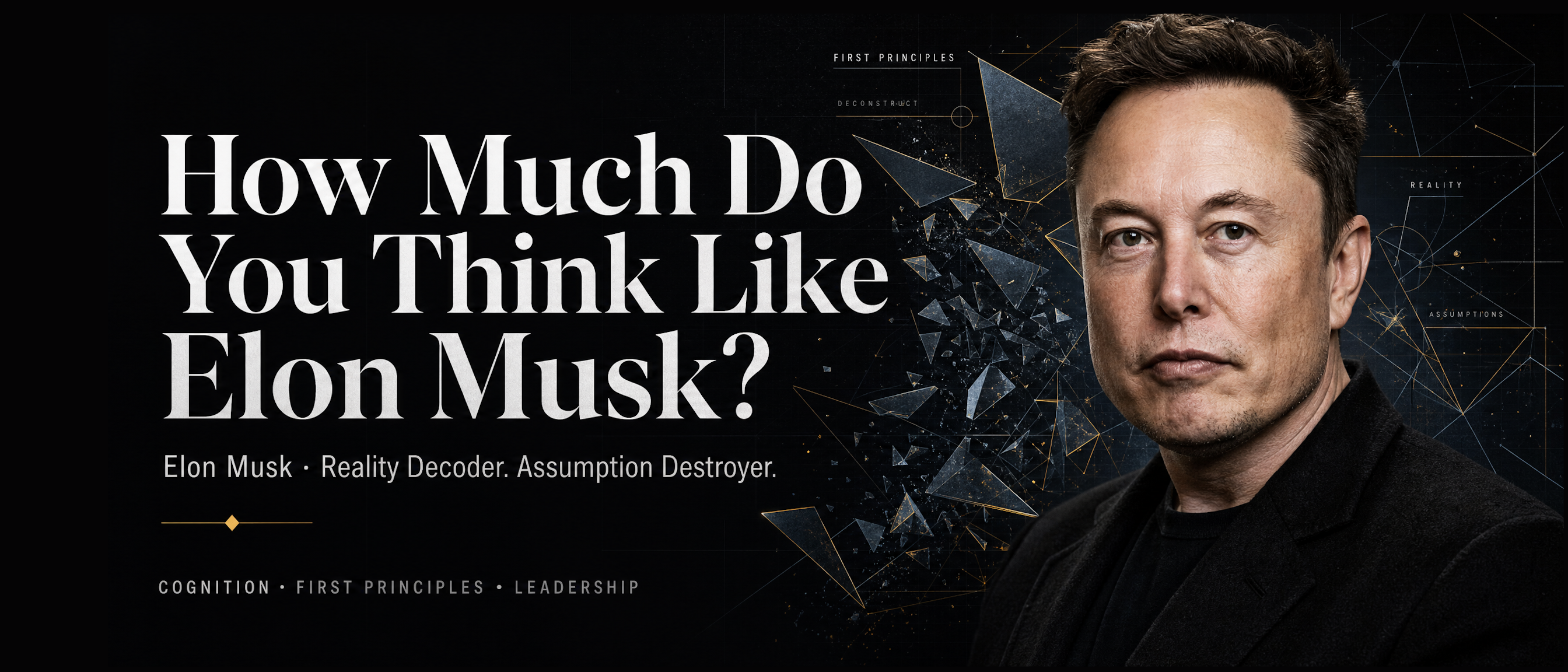
Musk has described his own approach, repeatedly and in public, as reasoning from first principles rather than by analogy. In a 2012 interview and many times since, he framed it plainly: most people, most of the time, decide what to do by looking at what has already been done and adjusting slightly. That is reasoning by analogy — cheap, fast, socially safe, and usually correct. First-principles reasoning throws the reference class away. It asks what is actually, physically, irreducibly true about a problem, and rebuilds the answer from there.
His most-cited public example is batteries. Around 2013 he described breaking a battery pack down to its raw materials — the nickel, cobalt, aluminum, and carbon traded on the metal markets — and calculating what those elements cost on their own. The number was a small fraction of what a finished battery cost at the time. The conclusion he drew was not that batteries are expensive, but that everyone had accepted battery cost as a fixed fact rather than a problem to be decomposed. The same move shows up in reusable rockets. The aerospace industry treated a rocket as something you use once, because it always had been. Musk treated single-use as an assumption to be attacked. On December 21, 2015, a Falcon 9 booster returned and landed upright.
There is a name for what this cognitive style is doing, and it sits underneath Musk's own vocabulary. Some minds treat reality as a system to be decoded — a structure whose rules can be inspected, stress-tested, and rebuilt — rather than as a web of relationships to be managed and kept intact. For that kind of mind, an inherited framework is only worth keeping if it survives inspection, and it gets discarded without ceremony if it doesn't. That description is a lens, not a diagnosis. But it captures something the great-man story cannot: this is not raw horsepower. It is a particular relationship to received wisdom.
And it is expensive. The brain is built to conserve energy, and analogy is how it conserves. Reasoning by analogy lets you borrow the accumulated conclusions of everyone who came before you, which is why it is the default and why, most of the time, it works. Decomposing a problem to its foundations and rebuilding it burns far more of the prefrontal cortex's limited budget, demands tolerance for long stretches of not-knowing, and produces answers that often contradict the consensus. Which points to the real cost — and it is not mainly mental.
What It Costs Him
When you reject the framework everyone else is using, you are also rejecting the agreement that holds groups together. Consensus is not just intellectual laziness; it is social glue. A mind optimized to attack assumptions is, by the same design, a mind poorly optimized for the small diplomatic maintenance that keeps people comfortable. This is not a flaw bolted onto the talent. It appears to be the same trait, seen from the other side.
You can read Musk's more costly public episodes through this frame without armchair psychology. The 2018 tweet claiming funding was secured to take Tesla private — which drew an SEC settlement and cost him the chairmanship — has the fingerprints of a mind that trusts its own reconstruction of a situation over the established rules for what a CEO is allowed to say out loud. The public friction, the abandoned norms, the willingness to alienate the very people whose approval would make his life easier: these are not separate from the thinking that lands rockets. They look like the same operating system, running without the social governor most people never think to remove.
This is the part the admiration usually skips. The trait that lets someone see a fixed cost as a solvable problem is the same trait that lets them see a social norm as an optional constraint. You do not get to keep one and return the other. It comes as a set.
The Pattern You Already Know
Strip away the rockets, and the underlying choice is one you make constantly, usually without noticing. Every problem you face, you meet with one of two moves. You either ask how this is normally handled — and borrow the answer — or you ask what is actually true here and build your own. The first is faster, safer, and right most of the time. The second is slower, lonelier, and the only one that produces anything genuinely new.
Most of us reason by analogy far more than we admit. We pick careers by watching what people like us did. We price our work by what others charge. We decide what a good life looks like by scanning the ones around us and adjusting at the margins. None of this is stupidity; it is the brain doing exactly what it evolved to do, conserving energy by standing on other people's conclusions. The cost is invisible precisely because it is the default — you never see the original answer you didn't build.
The honest insight here is not that first-principles thinking is better. It is that each mode has a price, and most people pay the analogy price without ever knowing there was a menu. First-principles reasoning is more original and more expensive — socially, emotionally, and neurologically. Analogy is cheaper and quieter, and for most decisions it is the correct tool. The skill Musk's public record actually demonstrates is not that he always decomposes. It is that he seems to know, on the decisions that matter most to him, that decomposing is an option — and to accept the bill when he chooses it.
The Uncomfortable Question
Here is what is worth sitting with.
The reason most people do not think from first principles is not that they can't. It is that no one told them the price upfront, so they never made the choice consciously — they simply defaulted to borrowing, on everything, forever. And the reason most people find Musk's behavior baffling is that they want the outputs of the trait without the outputs they find embarrassing, as though a person could be surgically separated from the shape of their own mind.
So the question isn't really about Elon Musk. It's about your own defaults. On the handful of decisions that will actually determine how your life goes — the work, the relationships, the bets — are you reasoning from what is true, or from what is done? And if it's mostly the latter, is that a choice you made, or one that was made for you by a brain doing what brains do?
Most people will never ask, because they never realize there was a choice to make. That is the cost of the cheap path. It's just that nobody sends you the bill.