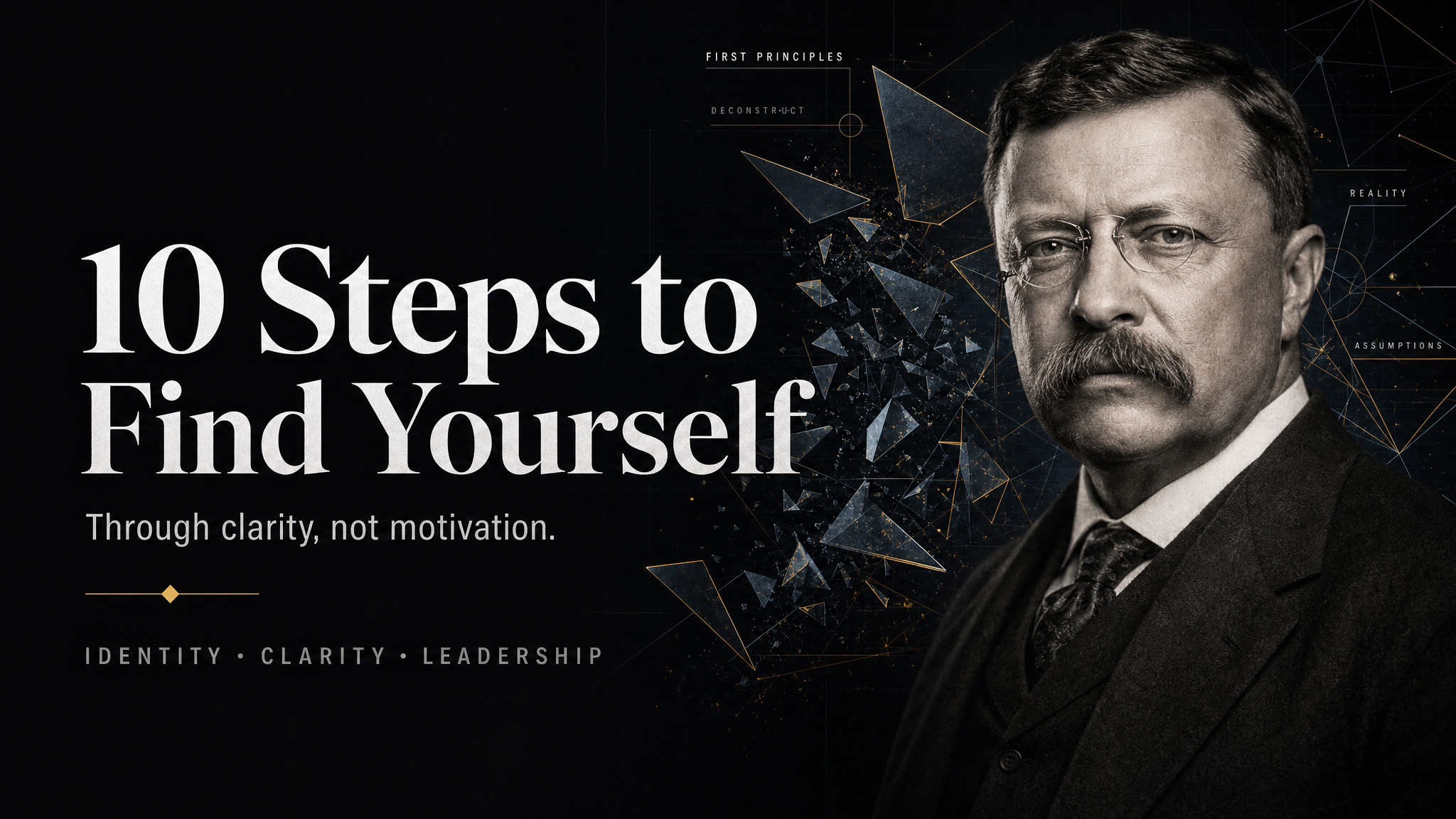
On February 14, 1884, Theodore Roosevelt wrote a single line in his diary. Just a hand-drawn black cross, and beneath it: "The light has gone out of my life."
His wife had died of kidney failure. His mother had died of typhoid — in the same house, twelve hours earlier. He was 25 years old, a rising New York politician, and by every external measure, his story was over.
He was wrong. But not because of resilience in the motivational-poster sense. What happened next in Roosevelt's life is one of the most instructive case studies in how the human brain actually rebuilds itself — and what that process demands.
The Brain That Was Never Supposed to Work
Roosevelt was born asthmatic, near-sighted, and physically frail. His father looked at him and said something that would have destroyed a different child: "You have the mind, but you have not the body. You must make your body."
This is where most people expect a story about willpower. It isn't.
What happened was neurological. Young Theodore was handed a choice between two identities — the sick child the world saw, and the one his father suggested was possible. His brain, still in its developmental peak, had to choose which neural architecture to build toward.
He chose. Obsessively. Boxing, hiking, horse riding — not as therapy but as deliberate identity construction. The brain, confronted with consistent behavior, updates its model of the self. By the time Roosevelt reached Harvard, the frail child was gone. Not replaced by bravado — replaced by a man whose physical confidence was earned through thousands of hours of overriding his own fear signals.
"Identity is not discovered. It is built — one repeated behavior at a time. The brain does not know who you are. It knows what you keep doing."
The Badlands Protocol
After February 14, 1884, Roosevelt did something counterintuitive. He did not push through. He did not perform grief. He did not return to politics and channel his pain into purpose — at least, not yet.
He left.
He went to the Badlands of North Dakota, bought a cattle ranch, and spent two years doing hard physical labor in extreme weather. He hunted. He read. He worked with his hands. He did not make major decisions.
From a neuroscientific perspective, this is exactly right. The brain's default mode network — most active during rest, physical work, and non-directed thought — is where deep integration happens. Trauma, unprocessed, calcifies into pattern. Trauma given space becomes information.
Roosevelt didn't escape to the Badlands. He gave his brain the conditions it needed to process the catastrophic loss of his two most important attachment figures — and to decide, without forcing, who he would be next.
He came back ready. Not healed in the simple sense — but reorganized.
"He didn't push through the grief. He gave his brain time to cook. Most people mistake doing nothing for doing nothing."
Do What You Can, With What You Have, Where You Are
The Badlands also produced something else: a philosophy forged not in a study but in actual scarcity.
Roosevelt arrived with political connections, an Ivy League education, and a family name — and none of it was worth anything in the Dakota Territory. What he had was a body he had built, a mind trained by years of voracious reading, and the ability to show up and work without complaint.
The famous line — "Do what you can, with what you have, where you are" — is typically quoted as inspirational shorthand. It was actually a survival principle developed by a man who had lost everything and was trying to find what remained useful.
This is the cognitive move most people miss: taking genuine inventory of actual assets, not hypothetical ones. Not the career you wish you had — the skills you demonstrably have. Not the network you want — the relationships you can actually activate.
Roosevelt's later presidency — the trust-busting, the conservation, the Square Deal — was built on this same principle applied at national scale. He worked with the political system as it existed, not as he wished it to exist.
"The most dangerous question is not 'What do I want?' It is 'What do I actually have to work with?' Most people never answer it honestly."
The Arena Speech and the Neuroscience of Risk
In 1910, a year after leaving the White House, Roosevelt gave a speech at the Sorbonne in Paris. It contained the most precise description of what the fear-action relationship actually looks like from the inside:
"It is not the critic who counts; not the man who points out how the strong man stumbles, or where the doer of deeds could have done them better. The credit belongs to the man who is actually in the arena, whose face is marred by dust and sweat and blood."
This is not a pep talk. This is a description of a specific neural dynamic.
The brain's threat-detection system — the amygdala — does not distinguish well between physical danger and social danger. Criticism, rejection, public failure — these register as threats. The critic, watching from outside the arena, activates no threat response. They are safe. The man in the arena is not safe — and chooses to be there anyway.
Roosevelt knew this from Kettle Hill in 1898, where he led the famous charge under fire. He later admitted he had been afraid. He went anyway. The action was not the absence of fear — it was the override of it, sustained long enough for momentum to take over.
The brain changes under this condition. Fear faced and survived is reregistered. The threat response recalibrates. You do not become fearless — you become someone whose fear threshold for that specific domain rises. This is the only known mechanism for building genuine courage.
"Roosevelt was not fearless. He was someone who had practiced overriding fear long enough that the override became faster than the fear."
The Desire Chain at Presidential Scale
When historians ask what drove Roosevelt, the answers vary: ambition, patriotism, ego, ideology. All of these are surface-level.
Pull the thread.
He wanted power. Why? To enact policy. Why? To protect ordinary Americans from corporate monopolies. Why? Because he believed in fairness as a foundational value — specifically, that the rules of the game should be the same for everyone regardless of wealth.
Follow that chain to its end and you arrive at something simple: he wanted to live in a world that was fair. Not equal by outcome — fair by process. That was his actual desire. The presidency, the speeches, the legislation — these were all proxies.
Understanding his true desire also explains his failures. His relationships were often strained, his approach sometimes bludgeoning rather than persuasive, his certainty occasionally blind. These were the costs of a man who had identified his core value so completely that he lost patience with the complexity of other people's different chains.
Purpose this concentrated is a double-edged asset. It produces extraordinary momentum. It also narrows peripheral vision.
"Every desire is a matryoshka doll. You have to open every layer to find the one that actually runs the show."
What Your Brain Can Take From His
Theodore Roosevelt is not a template. He was a specific person, shaped by specific losses and privileges, operating in a specific historical moment.
But his cognitive architecture offers something that transcends biography.
He understood — earlier and more viscerally than most — that the self is not found. It is built. That clarity comes not from introspection alone but from action, loss, recovery, and honest inventory. That fear is not a disqualifier but a signal that the arena is real. That desires, traced to their root, reveal what actually matters.
Most people spend years waiting for the version of themselves they imagine existing somewhere ahead. Roosevelt spent his life building that version — incrementally, obsessively, through a series of choices that often looked like they would break him.
They didn't.
"The light went out of his life on February 14, 1884. He went west. He came back President. That is not a metaphor. That is what the brain can do when you give it the right conditions and refuse to stay still."