People
Marriage & Relationships
The science of partnership, intimacy and repair.

Married Men Aren't Unhappy. They're Un-Recovered.
There's a man sitting in his driveway right now, engine off, scrolling nothing, going nowhere. His family is twenty feet away. He loves them. He is not ready to walk through the door. What looks like avoidance is actually neuroscience — and understanding the difference might be the most useful thing a couple can do.
Sep 2, 2026 · 12 min read
You Think You Understand Your Partner. You Don't.
Research on empathic accuracy shows that even in long-term couples, partners correctly read each other's emotional states only about 35% of the time during conflict — yet report being highly confident in their interpretations. The person you think you're fighting with may be a character your brain assembled years ago. Understanding why changes everything about how you listen.
Aug 26, 2026 · 12 min readCatching Yourself Mid-Fabrication: The Argument in Your Head Was Never Real.
A one-word text arrives. 'Fine.' Your brain immediately writes a full screenplay — anger, dismissal, a relationship in quiet crisis. Two hours later you find out the sender was rushing between meetings. You were never reacting to a text. You were reacting to a story your brain authored without your permission. This is not an occasional glitch. According to neuroscience, it's the standard operating procedure.
Aug 19, 2026 · 13 min read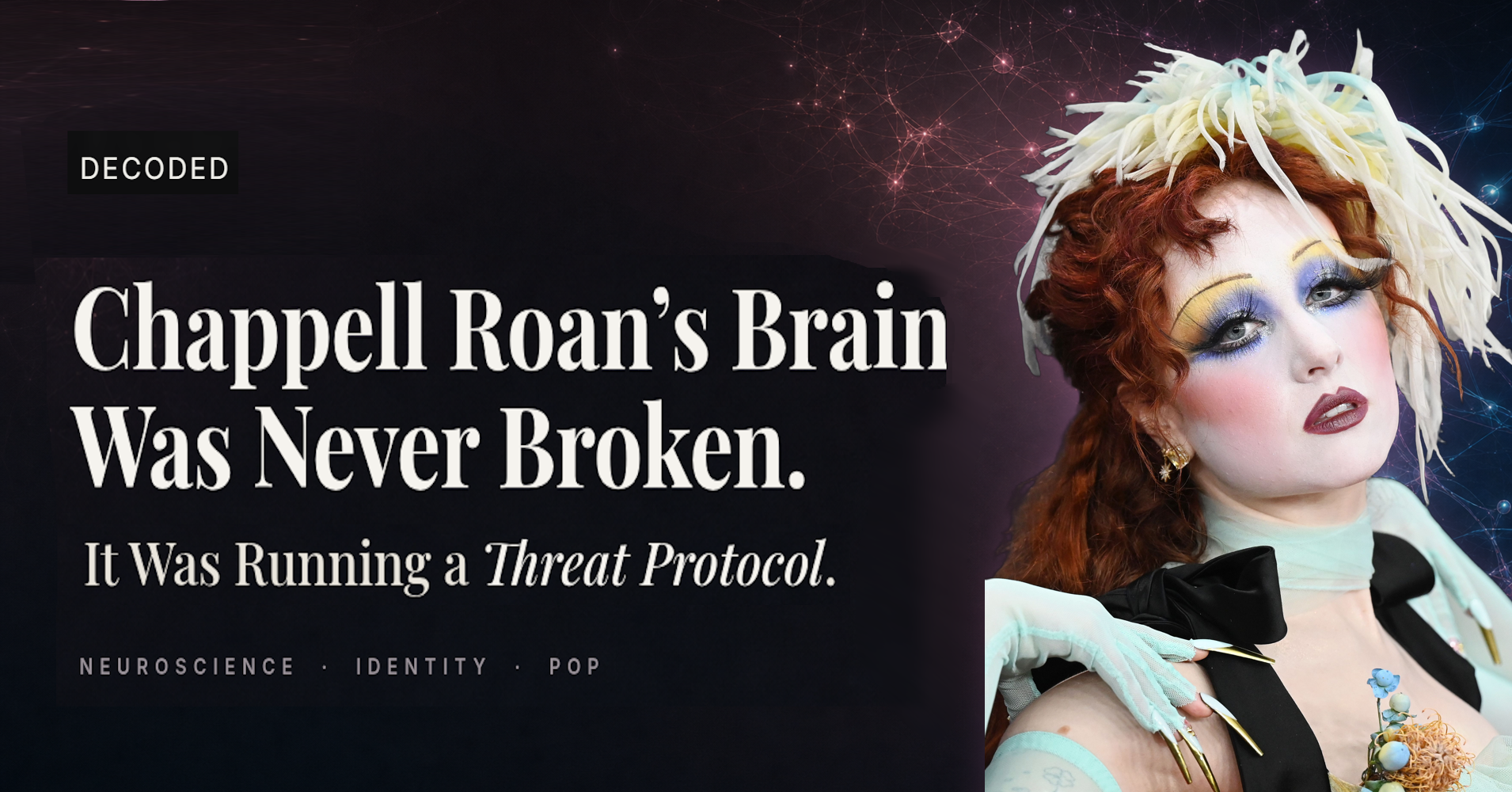
Chappell Roan's Brain Was Never Broken — It Was Running a Threat Protocol
In August 2024, Chappell Roan looked directly into her phone camera and told millions of people she didn't owe them anything. The internet called it a crisis. Neuroscience calls it a threat response. The difference between those two readings matters more than most people realize — and not just for her.
Aug 17, 2026 · 12 min readWhat If the Most Satisfying Explanation for Your Relationship Pain Is Also the Most Incomplete One?
When the brain experiences relational pain, it reaches for the fastest available explanation. In contemporary America, that explanation increasingly comes pre-packaged: he's an abuser, a narcissist, a gaslighter. The label feels like the end of a long search. Neuroscience suggests it may be the beginning of a longer confusion.
Aug 14, 2026 · 13 min readPerfectionism Isn't a Personality Trait — It's a Childhood Survival Program You Forgot to Uninstall
Perfectionism is not ambition. It is not a personality trait or a productivity edge. It is a survival strategy built in childhood that is now running on adult hardware — and it is charging you for the privilege. The tax comes out of your cognitive bandwidth, your relationships, and your capacity for joy. The question is not how to perform better. It is whether you want to keep paying.
Aug 5, 2026 · 12 min readMel Robbins Isn't a Motivational Speaker. She's Selling the One Thing America Forgot It Already Has.
In 2008, Mel Robbins was a Dartmouth and Boston College Law graduate who couldn't get out of bed. What she reverse-engineered from that paralysis became one of the most-watched ideas in TEDx history. The real question isn't why her method works — it's why so many of us needed someone to invent it in the first place.
Aug 3, 2026 · 12 min readStop Thinking Harder About Your Biggest Decisions — Your Brain Works Better When You Get Out of Its Way
Your conscious mind can reliably hold about four pieces of information at once. Most major life decisions involve fifteen or more variables. That gap isn't a character flaw — it's a hardware constraint. And there's a neurologically honest way to work around it.
Jul 29, 2026 · 13 min read